Miller MIG Welders for Sale
When you need a dependable welding machine for fabrication, repair, maintenance, or shop work, choosing the right MIG welder starts with understanding the machine’s output, capabilities, condition, and intended application.
At Welder Vault, we offer used Miller MIG welders for sale for welders, contractors, fabricators, repair professionals, farms, automotive shops, and businesses looking for quality welding equipment.
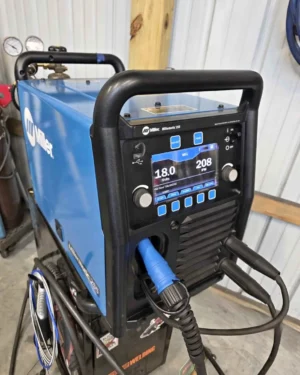
Miller Electric’s Millermatic® family includes MIG and flux-cored welding machines designed for applications ranging from smaller welding projects to professional fabrication and manufacturing. Current and legacy models vary considerably in output, input power, portability, and features, so each machine should be evaluated according to its specific specifications.
Our inventory changes regularly. Available models, condition, hours where applicable, accessories, pricing, and specifications will vary by machine.
Why Consider a Used Miller MIG Welder?
MIG welding, also known as Gas Metal Arc Welding (GMAW), uses a continuously fed wire electrode to create the weld. Flux-cored welding (FCAW) uses a tubular flux-cored wire and can be supported by many MIG machines.
Miller’s Millermatic range includes machines supporting MIG and flux-cored processes, with models designed for applications including fabrication, maintenance and repair, farm and ranch work, manufacturing, automotive work, and general welding projects.
Depending on the model, a Miller MIG welder may provide:
- MIG and flux-cored welding
- Adjustable voltage and wire-feed speed
- Digital displays
- Multiple input-voltage options
- Spool-gun compatibility
- Aluminum welding capability on compatible configurations
- Portable inverter designs
- Higher-output shop configurations
- Multi-process capability on selected models
The important point is that Miller MIG welders are not all the same. A compact 120/240V machine and a larger industrial MIG welder can have very different output capabilities and electrical requirements.
Miller Millermatic MIG Welders
The Millermatic name is associated with Miller’s MIG welding equipment. The product family includes machines ranging from portable models to larger shop and industrial machines.
Miller currently lists models including the Millermatic 142, 211 PRO, 252, 255, and 355, among others. Their specifications differ in input power, amperage, material thickness, wire-feed speed, portability, and supported applications.
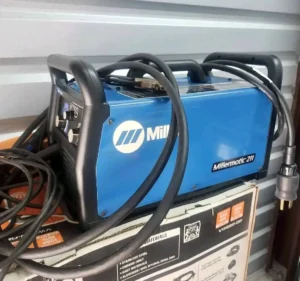
Miller Millermatic 211
The Millermatic 211 is a compact MIG and flux-cored welder designed for projects, farm and ranch applications, racing/custom work, and other uses. Miller lists an amperage range of 30–230 amps, with 120V and 240V input capability depending on configuration.
Its compact size can make this type of machine useful when portability and flexible input power are important.
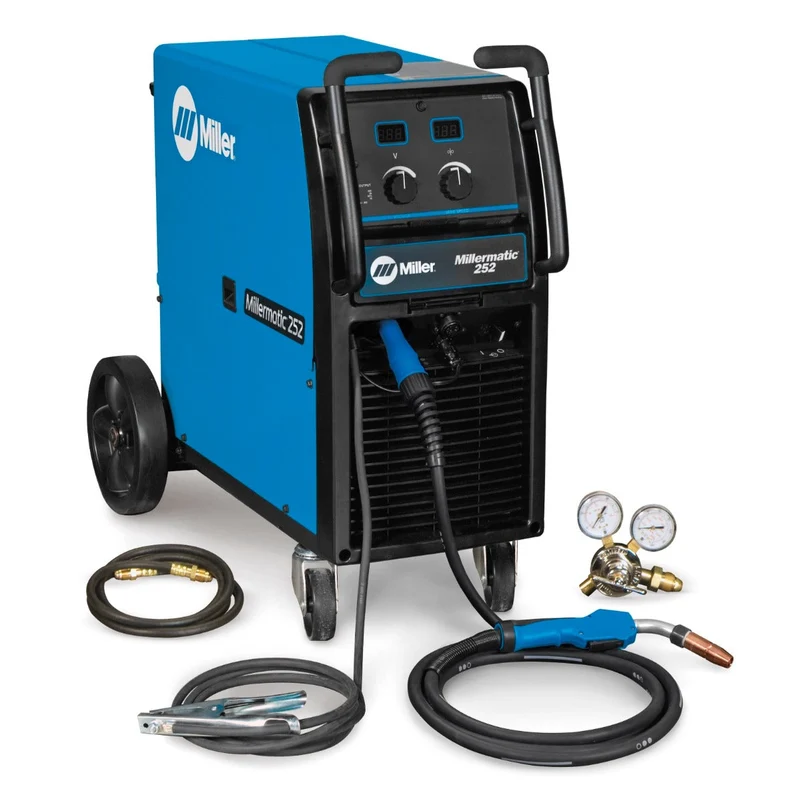
Miller Millermatic 252
The Millermatic 252 is a higher-output MIG and flux-cored welding machine intended for applications including fabrication, manufacturing, farm and ranch work, automotive welding, and mobile fabrication/maintenance. Miller lists a 30–300 amp range and rated outputs of 200 amps at 24 VDC at 60% duty cycle and 250 amps at 26.5 VDC at 40% duty cycle.
Depending on configuration, the Millermatic 252 can support materials including steel, stainless steel, and aluminum.
Miller Millermatic 255
The Millermatic 255 expands on the capabilities of the traditional MIG platform with MIG, pulsed MIG, and flux-cored welding capabilities. Miller lists it as part of the Millermatic family alongside the 211, 252, and 355.
If you are considering a used Millermatic 255, check the individual machine’s configuration and included equipment because features can vary.
Miller MIG Welders for Fabrication
MIG welding is widely used in fabrication because the continuous wire-feed process can provide productive welding when the machine is correctly configured for the material and application.
A used Miller MIG welder can be useful for:
Metal Fabrication
MIG welding is commonly used to fabricate frames, brackets, equipment, supports, machinery components, and other metal assemblies.
Maintenance and Repair
A MIG machine can be useful for repair departments and maintenance operations where steel and other compatible metals are regularly welded.
Farm and Ranch Work
Miller identifies farm and ranch applications among the intended uses of several Millermatic machines.
Automotive Work
MIG welding is widely used in automotive fabrication, repair, restoration, and related applications. The appropriate machine depends on material thickness, output requirements, wire size, and whether aluminum welding is required.
Manufacturing
Higher-output Miller MIG machines can be suitable for manufacturing and production environments when their duty cycle, output, input power, and process capabilities match the application.
What to Look for in a Used Miller MIG Welder
Buying used welding equipment requires more than looking at the brand and model number. The machine’s actual condition and configuration are important.
1. Welding Output
Check the amperage range and rated output. Your requirements will depend on the thickness and type of material you plan to weld.
For example, Miller lists the Millermatic 252 at 30–300 amps, with rated outputs depending on duty cycle.
2. Input Voltage
Always verify the electrical requirements before purchasing.
Some Miller MIG machines offer flexible 120/240V operation, while larger machines may require 208/240V or other configurations. The Millermatic 252, for example, is available in configurations supporting different input-voltage requirements.
3. Duty Cycle
Duty cycle tells you how long a welding machine can operate at a specified output during a defined period.
If the machine will be used for extended fabrication or production work, compare the rated duty cycle with your expected workload.
4. Wire-Feed Speed
Wire-feed speed affects the welding process and must be matched with the wire, material, voltage, and application.
Miller’s Millermatic 252, for example, lists a wire-feed-speed range of 50–700 IPM.
5. Wire Diameter
Check the supported wire diameters before purchasing. Different applications may require different solid or flux-cored wire sizes.
6. Spool-Gun Capability
If you plan to weld aluminum, check whether the specific Miller MIG machine supports a compatible spool gun.
Miller offers configurations of the Millermatic 252 specifically equipped for aluminum welding and spool-gun applications.
7. Physical Condition
Inspect the machine for:
- Damaged panels
- Corrosion
- Broken controls
- Damaged cables
- Worn MIG gun
- Wire-feed problems
- Damaged connectors
- Cooling/fan issues
- Missing accessories
- Signs of improper storage
- Excessive contamination inside the machine
When possible, test the machine under load rather than relying only on its appearance.
Used Miller MIG Welders vs. Multi-Process Welders
A dedicated MIG welder can be appropriate when MIG and flux-cored welding are your primary processes.
If you need several welding processes, a multi-process welder may provide greater flexibility.
Depending on the model, multi-process equipment can combine MIG, TIG, stick, and flux-cored welding in one machine.
You can explore our other welding equipment categories:
TIG Welders for Sale
If your Lincoln TIG/MIG pages use different final URLs, use those exact URLs in the links.
Miller MIG Welders for Shop and Mobile Applications
Your work environment should influence the type of MIG welder you choose.
A larger shop-based machine may be appropriate when you have reliable electrical service, dedicated welding space, and higher output requirements.
For mobile work, portability and available electrical power become more important. Smaller Miller MIG machines can be easier to transport, while larger units may provide additional output and features for demanding shop applications.
For engine-driven welding equipment, visit:
Used Miller Engine-Driven Welders
You can also explore:
How to Choose the Right Used Miller MIG Welder
Before selecting a machine, consider these questions:
What materials will you weld?
Determine whether you’ll primarily work with mild steel, stainless steel, aluminum, or other compatible metals.
How thick is the material?
Material thickness helps determine the output range and welding process you need.
Where will you use the machine?
A portable machine may be more practical for mobile repair work, while a larger shop machine may be appropriate for stationary fabrication.
What electrical power is available?
Confirm the machine’s required input voltage, phase, frequency, and amperage before purchasing.
Do you need aluminum capability?
If aluminum welding is part of your work, verify AC requirements and spool-gun compatibility for the specific machine.
Do you need TIG or stick welding?
If you regularly switch between processes, consider a multi-process machine instead of a dedicated MIG welder.
Why Choose Welder Vault?
At Welder Vault, we specialize in used welding machines and equipment, including Miller and Lincoln welders.
Our inventory can include:
- Used Miller MIG welders
- Used Lincoln MIG welders
- Miller Millermatic welders
- Engine-driven welders
- TIG welders
- Stick welders
- Multi-process welders
- Welding accessories and equipment
Every used machine is different, so we encourage customers to review the individual listing for the machine’s model, condition, specifications, photos, hours where applicable, included accessories, and availability.
View Used Miller Welders for Sale
Browse All Used Welding Machines
Miller MIG Welding Resources
For technical specifications, manuals, product information, and manufacturer documentation, visit Miller Electric.
Miller’s official Millermatic resource provides information on its MIG product family, including the Millermatic 211, 252, 255, and 355.
For example, Miller’s official documentation shows that the Millermatic 252 supports both MIG and flux-cored processes and provides model-specific information about amperage, wire-feed speed, input power, material thickness, and weldable metals.
These manufacturer resources are particularly useful when you need to verify the specifications of an older Miller machine.
Frequently Asked Questions
A Miller MIG welder is welding equipment designed for MIG/GMAW and, on many models, flux-cored/FCAW welding. Miller’s Millermatic family includes machines ranging from compact portable welders to higher-output equipment for fabrication and manufacturing.
Millermatic is Miller’s family of MIG welding machines. Different models have different output ranges, input requirements, portability, and features.
Some Miller MIG welders can weld aluminum when equipped and configured appropriately. For example, Miller lists aluminum as a weldable metal for the Millermatic 252 and offers a spool-gun aluminum package.
Many Millermatic machines support both MIG and flux-cored processes. The specific machine should be checked to confirm its supported wire sizes and configuration
MIG welders are designed for different applications. A larger machine may provide higher output, but a smaller machine may be more practical when portability, available electrical power, or lower-output work is more important. The appropriate choice depends on the application.