
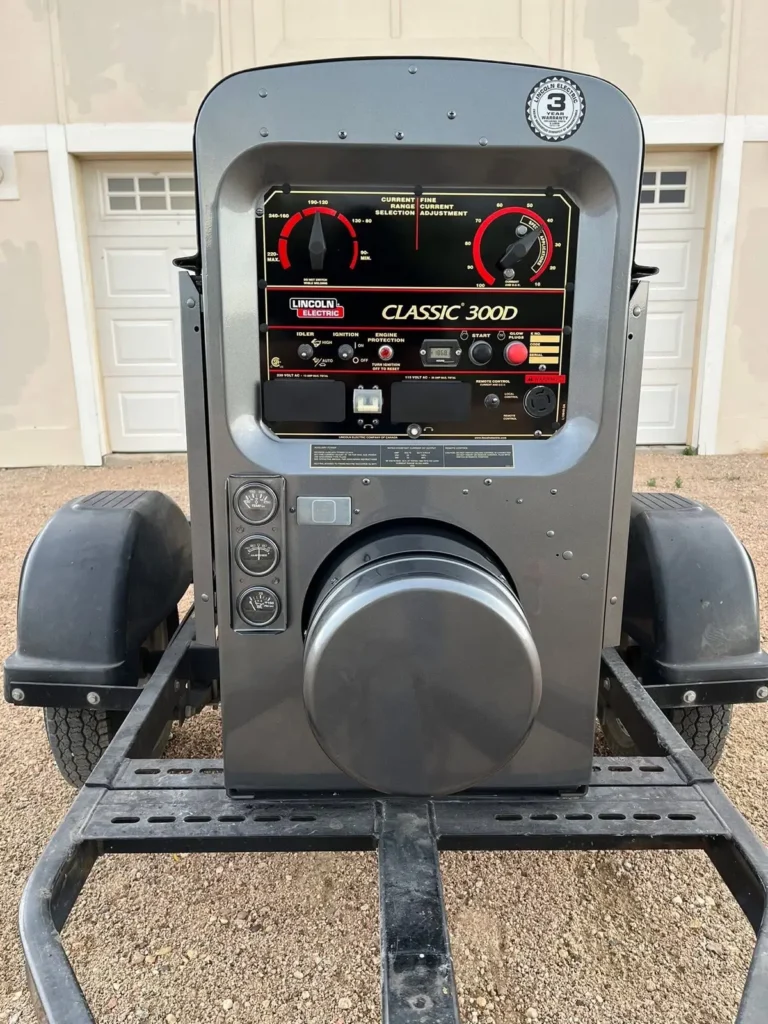
Lincoln Engine Driven Welders: Ranger, Vantage and Classic 300 Specs and Buying Tips
If you’ve been shopping for Lincoln engine driven welders for sale, you’ve probably noticed the lineup is confusing. There are gas Rangers, diesel Vantages and old-school Classics, and the same model name can have a different engine depending on the year. That matters a lot when you’re buying used.
This guide covers four machines we see most often: the Ranger 225, the Ranger 330MPX, the Vantage 500 and the Classic 300. For each one you’ll get the real specs, what it’s good at, and what to check before you hand over money.
Quick Answer
- Best all-around gas machine for farm and ranch work: Ranger 225. Light, simple and handles stick welding plus 9,000 watts of generator power.
- Best step-up for a service truck: Ranger 330MPX. More amps, 10,000 watts continuous, and more welding modes.
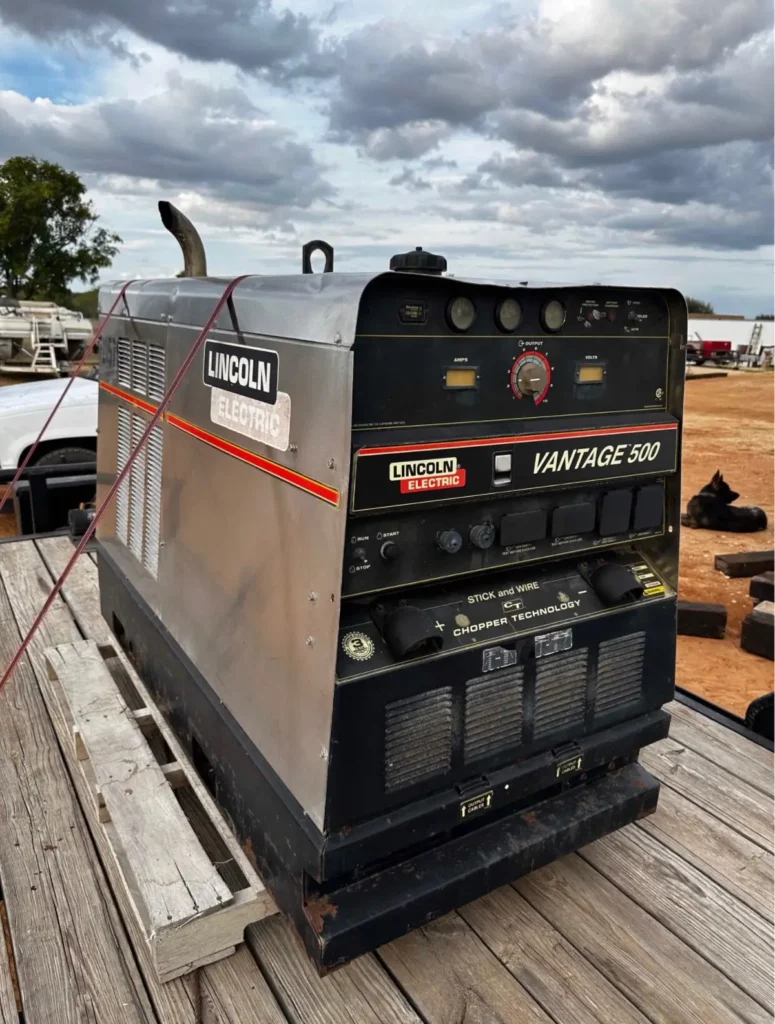
- Best for heavy fabrication, pipe and industrial sites: Vantage 500. 500 amps at 100% duty cycle and 20,000 watts of three-phase power.
- Best for pipe welders who want a traditional arc: Classic 300. Pure DC generator design, 300 amps at 60%, and only 3,000 watts of AC power.
- Before you buy any of them: check the hour meter, the engine’s oil condition and the data plate. Engines cause more problems than the welding side does.
Lincoln Engine Driven Welders at a Glance
| Ranger 225 | Ranger 330MPX | Vantage 500 | Classic 300 | |
|---|---|---|---|---|
| Engine | Kohler CH730, 23 hp gas | Kohler CH740, 25 hp gas (EFI version also made) | Diesel: Deutz, Cummins, Perkins or Kubota depending on version | Diesel: Perkins or Kubota (older versions also came in gas) |
| Weld output | 225 A at 40%, 210 A at 100% | CC-stick 35 to 330 A | 500 A at 100%, 550 A at 60%, 575 A at 50% | 300 A at 60%, 250 A at 100% |
| Generator power | 9,000 W continuous, 10,500 W peak | 10,000 W continuous | 12,000 W single-phase and 20,000 W three-phase | 3,000 W |
| Weight | About 514 lb | Lincoln says it is lighter than most machines in its class | About 1,440 to 1,600 lb depending on engine | About 1,350 lb (Perkins 300D) |
| Best for | Farm, ranch, light construction | Service trucks, maintenance, pipe | Heavy construction, pipe rigs, industrial | Pipeline, stick welding |
Specs are from Lincoln Electric and the manuals for each model. Used machines vary by year and engine, so always confirm against the data plate on the unit you’re buying.
Lincoln Ranger 225 Specs and What It’s Good For
The Ranger 225 (K2857-1) is the one most people picture when they think of a small Lincoln engine-drive. It’s a 225 amp DC welder with a 23 hp Kohler CH730 gas engine, rated at 225 A / 25 V at 40% duty cycle and 210 A at 100%.
The generator side is why a lot of ranchers buy it. It produces 10,500 watts peak and 9,000 watts continuous, enough to run a plasma cutter, a grinder, or backup power to a shop. It’s also small: about 514 lb, so it fits in a pickup bed.
What it does well:
- Stick welding on farm equipment, trailers, gates and structural repairs
- Scratch-start DC TIG
- MIG and flux-cored with an optional wire feeder (Lincoln lists the LN-25 series)
- Quiet for its class, rated at 76.4 dBA at 23 ft with the enclosed case
What it won’t do: it’s a DC machine, so there’s no AC output for aluminum TIG. And at 225 amps, it isn’t built for all-day heavy fabrication.
What to check on a used one: the Kohler engine is air-cooled, so look for oil leaks, listen for rough running or smoke, and check the hour meter. Confirm the battery door and fuel gauges work, since those are the parts that take abuse in a truck bed.
Lincoln Ranger 330MPX Specs and Uses
The Ranger 330MPX (K3459-1) is Lincoln’s modern step-up from the Ranger 225. It uses a 25 hp Kohler CH740 gas engine, delivers 330 A in stick mode (35 to 330 A), and puts out 10,000 watts of continuous clean power at 120/240V. Lincoln also sells an EFI (electronic fuel injection) version, the K4779-1.
Compared to the Ranger 225, you get more modes. Lincoln lists downhill pipe, touch-start pulse TIG and pulse spool gun operation, plus CV wire welding (14 to 40 V) and arc gouging (90 to 330 A). It has a digital interface and a maintenance screen that records engine hours.
That makes it a favorite for service trucks, pipe work and maintenance crews who want one machine that does more than stick welding.
What to check on a used one: because it’s a newer, more electronic design, confirm the digital display works and all weld modes respond. If you’re looking at the EFI version, ask about fuel-system history. Fuel injection adds capability but also more parts that can fail.
Lincoln Vantage 500 Specs and Issues to Know
The Vantage 500 is the heavy hitter. It delivers 500 A at 40 V and 100% duty cycle, 550 A at 36 V and 60%, and 575 A at 50%. Welding range is 30 to 575 A in CC and CV modes, and the Deutz version lists a 20 to 250 A TIG range.
The generator is just as strong: 12,000 watts single-phase and 20,000 watts three-phase power, both at 120/240V. That runs pumps, plasma cutters and industrial tools on a job site.
Here’s the part that trips up used buyers: Lincoln built the Vantage 500 with several different engines over the years. The specs for different versions show:
- Deutz F4L2011, 48 hp, about 1,532 lb
- Cummins B3.3, 53 to 56 hp, between about 1,443 and 1,605 lb depending on version
- Perkins 404D-22T, 43 hp, 20-gallon tank
- Kubota, 58 hp, on the Air Vantage 500
The welding side is similar across versions, but the engine determines parts availability, service cost and how the machine runs. Check the data plate to see which one you’re buying.
What to check on a used one: diesels reward good maintenance and punish neglect. Ask for service records, check the hour meter, and look at the exhaust for wet, oily residue, a sign the engine has run lightly loaded for long periods. Confirm the three-phase receptacle works. If it also has an air compressor, test that too.
Lincoln Classic 300 Specs and Why Pipe Welders Like It
The Classic 300 is a different kind of machine. Lincoln builds it on a pure DC generator design with all-copper windings, which gives a smooth, stable arc that pipe welders prefer for stick work. It’s rated at 300 A at 60% duty cycle (250 A at 30 V at 100%), with an output range of 40 to 350 A.
The trade-off is generator power: only 3,000 watts of AC, enough for a grinder or lights, not a shop. It’s a welder first.
It came in several versions: the Classic 300D (Perkins or Kubota diesel), the 300 HE (Kubota), and the newer Classic 300 MP, which adds CC/CV capability. Older Classic 300G models used gas engines. Lincoln’s listing for the 300 MP gives a 16-gallon tank and roughly 14.3 hours of constant welding at 300 amps, or about 64 hours at low or no idle.
What to check on a used one: because the arc comes from a rotating generator, ask about the condition of the brushes and the commutator or slip surfaces, and listen for unusual noise or vibration. The current control (five positions plus fine tuning) should step smoothly. As with any diesel, confirm hours and look for leaks.
What to Check Before Buying Any Used Lincoln Engine Driven Welder
The welding side is rugged. The engine is where most used machines show their age. Here’s the checklist we’d run:
- Read the hour meter, then compare it to condition. Low hours with leaks and neglect is worse than higher hours with records.
- Photograph the data plate. Confirm the model, serial number and engine version, especially on a Vantage.
- Cold start it. A machine that fires right up cold is a good sign. Hard starting, white or blue smoke, or knocking is not.
- Check the oil and coolant. Look for milky oil, low coolant and leaks around seals and hoses.
- Weld with it. Run a bead at low and high output. The arc should be steady across the range.
- Load the generator. Plug in something real and confirm every receptacle works and the voltage holds. (For safe use of generators and electrical equipment, OSHA’s electrical safety guidance is worth a look.)
- Test the idler. The engine should drop to idle and come back up when you strike an arc.
- Inspect the leads and connectors. Worn cables make a good machine feel weak. If yours need replacing, see our welding cables and leads.
For a deeper walk-through of inspecting a machine in person, see our guide on how to inspect a used welder before you buy. It covers many of the same checks.
Lincoln vs. Miller Engine-Drives: How They Compare
If you’re cross-shopping brands, the closest Miller equivalents are the Bobcat for the Ranger 225 and 330MPX class, and the Trailblazer or Big Blue for the Vantage class. We’ve written up both: the Miller Bobcat 225/250/260 guide and the Miller Trailblazer 302/325 guide. You can browse used Miller engine driven welders side by side with the Lincolns.
In general, both brands are built well and hold value. Lincoln’s strength is the pure-generator Classic arc and the Vantage’s output. Miller’s strength is its Bobcat and Trailblazer lineup and wide parts support. Your decision is more likely to come down to price, hours and condition than to brand.
Where to Find Lincoln Engine Driven Welders for Sale
We keep a running list of used Lincoln engine driven welders with model, engine and hours listed so you can compare. If you want to see the rest of our Lincoln inventory, including MIG welders, start at our used Lincoln welders for sale page, or browse the whole shop.
For official specs on any model, Lincoln Electric’s own pages are the best source. Here’s the Ranger 330MPX product page as an example of what to compare against.
Ready to Look at Machines?
Browse our current Lincoln engine driven welders and check hours, model and condition before you decide. If you have questions about a specific machine, get in touch and we’ll help you pick the right one for your work.
F.A.Q.
Supporting Subheading
The Ranger is a gas-powered, lighter machine for farm, ranch and service work, with 9,000 to 10,000 watts of single-phase generator power. The Vantage 500 is a diesel machine with much higher output (500 A at 100% duty cycle) and 20,000 watts of three-phase power, built for heavy construction and industrial use.
Yes, for stick welding and pipe work. Its pure DC generator design gives a smooth arc. The limit is generator power, since it only provides 3,000 watts of AC, so it’s not a good choice if you need to run a lot of tools off the machine.
The Ranger 225 produces 10,500 watts peak and 9,000 watts continuous of single-phase AC power.
Over the years Lincoln has built the Vantage 500 with Deutz, Cummins, Perkins and Kubota diesel engines. Check the data plate to see which one a used machine has, since it affects service and parts.
Read the hour meter, photograph the data plate, cold start it, check oil and coolant, weld with it, load the generator and test the engine idler. If you can, ask for service records.
Yes, with an optional wire feeder. Lincoln lists its LN-25 series feeders for MIG and flux-cored welding on the Ranger 225.