
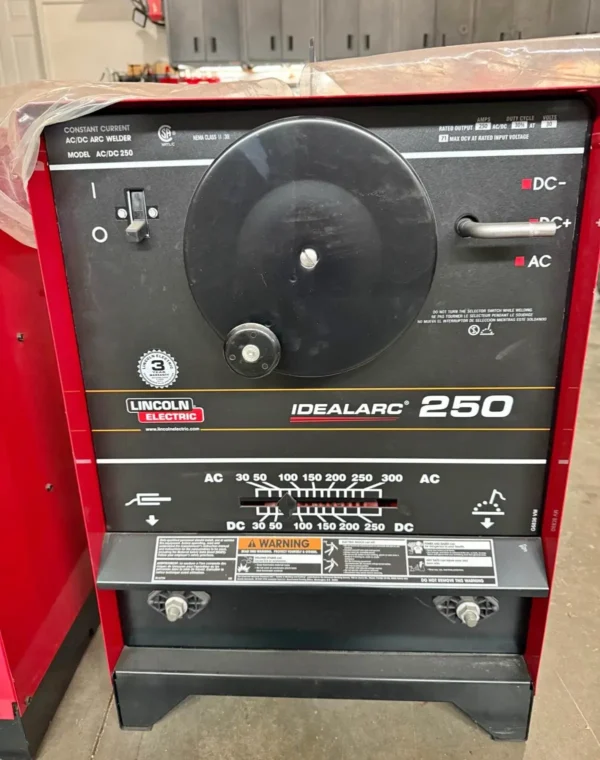
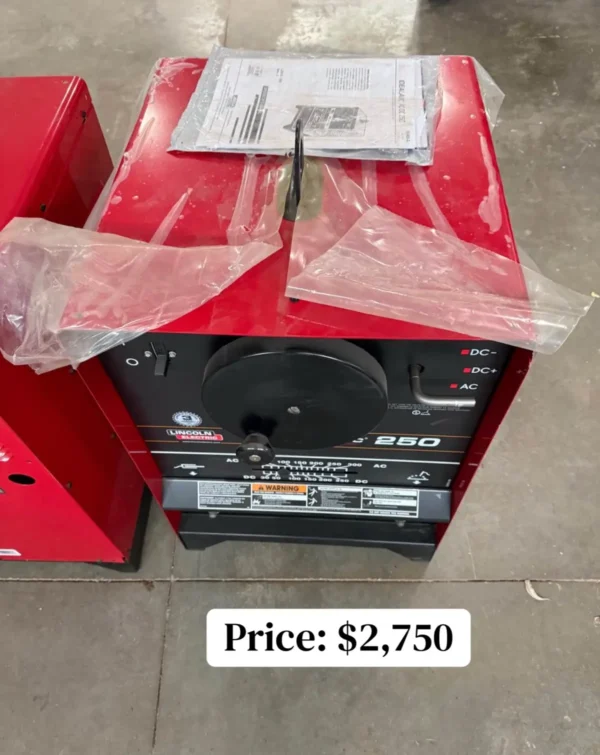

New Lincoln Idealarc 250 Stick Welder
The Lincoln Idealarc 250 Stick Welder is a heavy-duty, constant-current arc welder engineered for demanding SMAW (Stick) and DC TIG applications. Built on Lincoln’s proven Idealarc platform — a name synonymous with reliable transformer-based technology since the mid-20th century — this machine delivers a smooth, stable arc from 30 to 250 amperes across a wide range of electrode diameters.
Whether you’re running 6010 pipeline roots, 7018 structural fills, or 308L stainless rods, the Idealarc 250 maintains consistent output under load, even on long, undersized input leads. It is a premium-condition unit, ready for immediate production use, and built for contractors, fabricators, and maintenance welders who need an honest, no-frills machine that starts fast and runs all day.
The unit is air-cooled, requires no water plumbing, and uses a rugged copper-wound transformer that resists vibration and thermal stress better than aluminum-wound equivalents. With a 60% duty cycle at 200 amps, it is well suited for continuous shop fabrication with only brief cooling pauses at maximum output.
Key Features
- Heavy-duty constant-current DC stick welder
- Proven Lincoln Idealarc transformer-based platform
- Smooth, stable arc from 30 to 250 amps
- Excellent performance for SMAW and DC TIG applications
- High open-circuit voltage for easy arc starts
- 60% duty cycle at 200 amps
- 30% duty cycle at 250 amps
- Air-cooled design with fan-on-demand operation
- Rugged copper-wound transformer construction
- Grain-oriented silicon steel laminations for low core loss
- Heavy-gauge steel enclosure with powder-coat finish
- Twist-Mate™ output connections for secure cable attachment
- NEMA 3R enclosure rating for industrial environments
- Compatible with a wide range of stick electrodes
- Reliable performance on long input leads and demanding jobsites
Specifications
| Specification | Details |
|---|---|
| Model | Lincoln Idealarc® 250 Stick Welder |
| Condition | New / Premium Condition |
| Machine Type | Constant-Current Arc Welder |
| Output Type | DC Constant Current (CC) |
| Welding Output Range | 30 – 250 A |
| Open Circuit Voltage | 80 V |
| Duty Cycle @ 200 A | 60% |
| Duty Cycle @ 250 A | 30% |
| Input Voltage | 230/460/575 V, 3-phase, 60 Hz |
| Input Amperage @ 230 V | 50 A |
| Processes | SMAW (Stick), DC TIG (scratch start) |
| Electrode Capacity | 3/32 in – 5/16 in diameter |
| Cooling | Air-cooled, fan-on-demand |
| Weight | 220 lb (100 kg) |
| Dimensions (H × W × D) | 23.0 × 14.5 × 32.5 in |
| Output Terminals | Twist-Mate™ (included) |
| Enclosure Rating | NEMA 3R |
Superior Stick Welding Performance
The Lincoln Idealarc 250 is built to deliver dependable DC Stick welding performance for a wide range of fabrication and repair projects. Its stable constant-current output helps produce strong, consistent welds with excellent penetration and reduced arc wander.
The machine performs especially well with common electrodes such as:
- E6010
- E6011
- E7016
- E7018
- E308L
- E309
- E310
- Hardfacing electrodes
Its 80-volt open-circuit voltage provides excellent arc starting characteristics, making it ideal for moisture-sensitive low-hydrogen electrodes and demanding field applications where reliable restarts matter.
Transformer-Based Reliability
Unlike lightweight inverter machines, the Idealarc 250 uses a rugged transformer-based design that is known for durability, simplicity, and long service life. The transformer core is constructed from grain-oriented silicon steel laminations for low core loss, while the primary and secondary windings use heavy-gauge copper conductors for dependable current delivery.
The case is formed from 14-gauge steel with a powder-coat finish that resists oil, flux spatter, and UV degradation. All terminal connections use Lincoln’s Twist-Mate™ system, helping eliminate cable slippage under vibration and ensuring a secure electrical connection in tough working conditions.
Best Applications
The Idealarc 250 excels in the following scenarios:
Structural steel fabrication
Run E7018 and E7016 electrodes on I-beams, gussets, and column bases at 140–180 amps. The smooth CC output helps prevent undercut at weld toes, which is critical for code-quality joints under AWS D1.1.
Pipeline maintenance and tie-ins
Cellulosic electrodes such as E6010 and E6011 respond well to the Idealarc’s high open-circuit voltage, which supports fast restrike and quick arc establishment for pipeline welders working in wind or on vertical seams.
Shipbuilding and plate work
At 250 amps, the Idealarc 250 burns 5/16 in electrodes for rapid fill on heavy plate. The 30% duty cycle at maximum amperage is suitable for intermittent heavy passes followed by inspection periods.
Maintenance and repair welding
The wide amperage range and tolerance for variable power conditions make this machine reliable for field repair where generator power or long extension cord runs are unavoidable.
Stainless steel and hardfacing
DC straight polarity (DCEN) settings support E308, E309, and E310 stainless rods as well as hardfacing electrodes used on wear-intensive equipment like bucket teeth and conveyor screws.
How to Use the Lincoln Idealarc 250
Initial setup begins at the input terminal block on the rear panel. Match the tap setting to your facility’s supply voltage — 230, 460, or 575 V — using the three-position reconnect board. Tighten all terminal lugs to 45 in-lb torque to prevent arcing at the connection points.
For standard SMAW (Stick) welding:
- Connect the electrode cable to the (+) Twist-Mate output terminal and the work cable to the (−) terminal for DCEP (reverse polarity), which is correct for most iron-powder and low-hydrogen electrodes such as E7018, E7016, and E6013.
- Use DCEN (electrode to minus) for cellulosic rods such as E6010 when higher arc force is not needed.
- Set the output control dial to the midpoint of the manufacturer’s recommended amperage range printed on the electrode carton, then fine-tune based on arc behavior.
- A hissing, violent arc indicates too much amperage; a stubby, sticking arc indicates too little.
- Strike the arc with either a scratch or tap start. The Idealarc’s 80 V OCV provides ample starting voltage to ignite even moisture-sensitive low-hydrogen electrodes.
- Maintain a 1× electrode-diameter arc length for E7018 and a 1.5–2× arc length for E6010 root passes.
For DC TIG (scratch start):
- Set output to DCEN
- Reduce amperage to your material thickness calculation as a starting point
- Use a scratch-start motion to initiate the arc
- A dedicated high-frequency start box, such as the Lincoln High Frequency Start HF-251D, can be added for non-contact starts on specialized TIG applications
Compatibility
The Idealarc 250 is compatible with the following Lincoln Electric accessories and consumables:
- Electrode holders: Lincoln Electric K875 300-A or K909-6 T300 electrode holder for 1/0 cable
- Work clamps: Lincoln K871 300-A C-clamp or K894 spring-loaded 400-A clamp
- Output cables: Lincoln 1/0 or 2/0 welding cable sets with Twist-Mate ends, including the K2394-1 stick electrode holder/work clamp cable set
- Remote amperage control: The Idealarc 250 includes a remote control receptacle accepting Lincoln’s K857 or K963 foot amptrol for TIG applications
- High-frequency start: HF-251D (sold separately) connects via the remote output terminals
See also: Lincoln K2394-1 Electrode Holder & Work Clamp Set — the standard cable package bundled with this machine in most shop configurations.
Built for Industrial Reliability
The Idealarc 250 is designed to withstand demanding work environments and continuous production use. Its rugged construction and proven engineering help minimize downtime while providing years of dependable service.
Additional advantages include:
- Heavy-duty steel enclosure
- Durable copper-wound transformer
- Low core-loss transformer design
- Air-cooled operation with no water plumbing required
- Fan-on-demand cooling system
- Reliable performance under load
- Secure Twist-Mate™ cable connections
- Long service life with minimal maintenance
Typical Applications
The Lincoln Idealarc 250 Stick Welder is commonly used for:
- Structural steel fabrication
- Pipeline welding and maintenance
- Construction projects
- Industrial maintenance
- Equipment repair
- Shipbuilding
- Plate work
- Stainless steel fabrication
- Hardfacing applications
- General fabrication
- Heavy-duty repair welding
Why Choose the Lincoln Idealarc 250?
The Idealarc 250 combines industrial durability, dependable welding performance, and straightforward operation in one powerful package. Its transformer-based design, high open-circuit voltage, and wide amperage range make it an excellent choice for professionals who need consistent performance in demanding environments.
Benefits include:
- Smooth and stable Stick welding performance
- Excellent arc starts and restrikes
- Reliable DC TIG scratch-start capability
- Rugged industrial construction
- Secure cable connections with Twist-Mate™ terminals
- Easy operation and simple maintenance
- Proven Lincoln reliability for long-term use
Why Buy From Us?
We supply quality welding equipment trusted by professionals across a wide range of industries. Every machine is carefully prepared to meet high standards for performance, reliability, and customer satisfaction.
Whether you’re outfitting a fabrication shop, replacing an older welder, or expanding your equipment fleet, the New Lincoln Idealarc 250 Stick Welder delivers the power, efficiency, and durability needed for demanding welding applications.
Contact us today for current pricing, availability, and fast shipping options.
Care & Maintenance
The Idealarc 250’s transformer-based design requires minimal maintenance compared to inverter machines, but a few simple practices will help extend service life significantly:
- Monthly air purge: Use low-pressure compressed air (25–30 PSI) to blow accumulated dust and flux particles from the transformer windings, fan blades, and internal bus bars. Do not use liquids or solvents internally.
- Terminal inspection: Inspect all Twist-Mate connections quarterly for corrosion or pitting. Apply an anti-oxidant compound if tarnishing is visible.
- Fan motor check: The fan-on-demand system activates above approximately 40°C internal temperature. Verify fan rotation monthly and listen for bearing noise during the first minute of operation.
- Output tap inspection: If output fluctuates at a fixed amperage dial setting, inspect the range switch contacts with the machine de-energized. Carbon scoring on switch contacts can be cleaned with fine emery cloth.
- Cable inspection: Visually inspect electrode and work cables monthly. Replace any cable with cracked insulation, kinked conductors, or arced terminal connectors immediately to prevent arc flash hazards.
- Annual calibration: Verify output amperage against the dial markings using a calibrated clamp-on ammeter at 100 A, 150 A, and 200 A settings. Drift greater than ±5% indicates a faulty range switch or shunt resistor.
Reviews
There are no reviews yet.